Understanding Moisture Content in Reclaimed Lumber
Moisture content is the single most important factor in wood performance. This technical guide covers everything you need to know about measuring, managing, and controlling MC for successful reclaimed wood projects.
Request a Free Quote
Fill out the form below and our team will get back to you within one business day.
What Is Moisture Content?
Moisture content (MC) is the weight of water in a piece of wood expressed as a percentage of the weight of the wood when completely dry (oven-dry weight). A board with 12% MC contains water equal to 12% of its oven-dry weight. Living trees can have MC values exceeding 200% in sapwood, meaning the water in the wood weighs more than twice what the wood itself weighs when dry.
Moisture content matters because wood is hygroscopic -- it absorbs and releases moisture in response to the relative humidity of the surrounding air. As wood gains moisture, it swells. As it loses moisture, it shrinks. This dimensional change is not uniform: wood moves very little along its length (less than 0.1%), moderately across its radial plane (3-5%), and significantly across its tangential plane (6-10%). These differential movement rates are what cause cupping, warping, bowing, and twisting.
For reclaimed lumber, moisture content takes on added importance. Reclaimed wood has already gone through many moisture cycles during its first life, and its cell structure may have been altered by decades of compression, heat exposure, or chemical treatment. Some reclaimed boards are more dimensionally stable than new lumber because their fibers have "set" over time, while others may be more reactive if they were stored in uncontrolled conditions after salvage.
Pin Meter vs. Pinless Meter
Two types of moisture meters are commonly used in woodworking. Each has strengths and limitations. Understanding both helps you choose the right tool for your situation.
Pin-Type Moisture Meter
Drives two metal pins into the wood surface and measures electrical resistance between them. Lower moisture content means higher resistance.
Advantages
- ✓Measures moisture at specific depth (pin length determines depth)
- ✓Can detect moisture gradients by using pins of different lengths
- ✓Highly accurate in the 6-30% MC range
- ✓Works on all wood species with proper species correction
- ✓Relatively inexpensive ($30-200)
Limitations
- ×Leaves two small pin holes in the wood surface
- ×Measures only the area between the pin tips
- ×Metal contaminants in reclaimed wood can give false high readings
- ×Requires species-specific gravity correction for accuracy
- ×Pins can bend or break in dense hardwoods
Spot-checking specific areas, measuring at depth, detecting moisture gradients in thick stock, and testing reclaimed wood where surface conditions may differ from core moisture.
Pinless (Dielectric) Moisture Meter
Emits an electromagnetic signal that penetrates the wood and measures the dielectric properties of the material. Higher moisture content changes the dielectric constant.
Advantages
- ✓Non-destructive -- does not leave marks on the wood surface
- ✓Measures a larger volume of wood per reading (typically 1-inch depth)
- ✓Faster scanning of large surfaces
- ✓Can scan finished or coated surfaces without damaging the finish
- ✓Good for identifying wet spots in installed flooring
Limitations
- ×Cannot distinguish between surface and core moisture
- ×Affected by surface moisture, condensation, and finishes
- ×Less accurate than pin meters in the critical 6-12% range
- ×Metal beneath the wood (nails, subfloor fasteners) causes false readings
- ×Higher cost ($100-500 for quality models)
Scanning large areas quickly, checking installed flooring and paneling, quality control during acclimation, and non-destructive testing of finished reclaimed wood surfaces.
Best Practice: Use Both
Professional woodworkers and flooring installers use both meter types. The pinless meter scans large areas quickly to identify problem spots, and the pin meter then provides precise readings at those specific locations. When testing reclaimed lumber, always take readings at multiple points along each board because MC can vary significantly from end to end, especially in boards that were partially exposed to weather during their first life.
Acceptable MC Ranges by Application
Different applications have different moisture requirements. Using lumber outside these ranges leads to performance failures that may not appear until months after installation.
Hardwood Flooring
6-8% MCFlooring must be dried to the lowest practical moisture content because it will be installed in a climate-controlled interior. Boards installed above 8% MC in the humid Gulf South climate risk cupping, buckling, and gapping as they equilibrate to indoor conditions. Most HVAC-controlled homes maintain interior humidity that corresponds to 6-9% EMC.
Interior Trim & Millwork
6-8% MCTrim, baseboards, crown molding, and window casings are installed in climate-controlled spaces and will remain there permanently. These pieces must be stable because gaps, cracks, and warping are highly visible on finished trim. Kiln drying to 6-8% MC ensures minimal movement after installation.
Cabinetry & Furniture
6-9% MCFurniture and cabinet components require low and consistent moisture content because joinery depends on dimensional stability. A drawer front that swells even 1/16 of an inch will bind. Tabletops that cup or bow become unusable. Kiln dry to 6-8% and acclimate in the shop for at least two weeks before milling to final dimensions.
Interior Paneling & Shiplap
8-10% MCWall paneling and shiplap have slightly more tolerance for moisture variation because the tongue-and-groove profile accommodates minor expansion and contraction. However, boards installed at significantly higher MC will shrink and expose unpainted tongue edges, creating visible lines. Target 8-10% for best results.
Structural Framing
12-15% MCStructural lumber can tolerate higher moisture content because it is typically concealed within wall cavities and is not subject to aesthetic concerns. The International Residential Code permits framing lumber up to 19% MC, but starting at 12-15% significantly reduces post-construction shrinkage that causes nail pops, drywall cracks, and floor squeaks.
Timber Beams (Exposed)
12-15% MCLarge timber beams take months or years to fully equilibrate due to their mass. Kiln drying reduces surface MC but the core may remain higher. For exposed beams, 12-15% surface MC is acceptable because minor checking (surface cracks) is considered character and does not affect structural performance. Deep checks that extend beyond one-third of the beam depth should be evaluated.
Exterior Decking
12-18% MCDeck boards are exposed to rain and humidity and will cycle between wet and dry conditions throughout their service life. Installing at 12-18% MC allows the boards to be in a mid-range state, minimizing initial movement. Boards installed too dry will absorb moisture and swell, potentially buckling. Boards installed too wet will shrink and gap excessively.
Exterior Siding
12-15% MCSiding is exposed to weather on one face but protected on the back. This differential moisture exposure causes cupping if the MC is too high at installation. Install at 12-15% and apply finish to all six sides (front, back, edges, and ends) to slow moisture exchange and equalize absorption rates.
Effects of Incorrect Moisture Content
Too Much Moisture (MC Too High)
- •Flooring buckles, crowns, and lifts off the subfloor as boards swell against each other
- •Doors and windows stick as frames expand beyond their openings
- •Mold and mildew develop on concealed surfaces where moisture is trapped
- •Finish adhesion fails because moisture migrates through the wood and pushes the finish off
- •Joints swell and can crack surrounding material as wood expands with tremendous force
- •Drywall adjacent to wet framing develops staining, mold, and nail pops
- •Structural connections lose holding power as fasteners are pushed out by swelling wood
Too Little Moisture (MC Too Low)
- •Gaps open between floorboards as wood shrinks, collecting dirt and appearing unsightly
- •End splits and surface checks develop as the wood dries unevenly
- •Glue joints fail as wood shrinks away from adhesive bonds
- •Tongue-and-groove connections loosen, causing squeaking floors and rattling panels
- •Furniture joints separate, legs wobble, and tabletops crack
- •Veneer delaminates from substrates as the core material shrinks
- •Reclaimed beams develop deep checking that may compromise aesthetic value
The Acclimation Process
Acclimation is the process of allowing wood to reach equilibrium with the moisture conditions of the space where it will be permanently installed. Even kiln-dried lumber needs acclimation because storage and shipping conditions may have altered its MC from the target value. The goal is to install wood that is already at or very near the MC it will maintain in service, minimizing post-installation movement.
To acclimate reclaimed lumber, stack it in the installation space with stickers (thin strips of wood) between each layer to allow air to circulate around every board. The HVAC system should be running at normal operating conditions -- do not acclimate in an unfinished space without climate control, as the conditions will differ from the final environment.
Monitor moisture content daily with a pin meter. When readings stabilize within one percentage point of your target for three consecutive days, the wood is acclimated and ready to install. For hardwood flooring, also check the moisture content of the subfloor -- the difference between the flooring and subfloor should not exceed 2-4 percentage points depending on species.
Acclimation typically takes 5 to 14 days for kiln-dried lumber and 2 to 4 weeks for air-dried stock. In the Gulf South, summer acclimation tends to be faster because the high ambient humidity quickly brings dry lumber up to equilibrium, while winter acclimation (when indoor heating lowers humidity) may take longer.
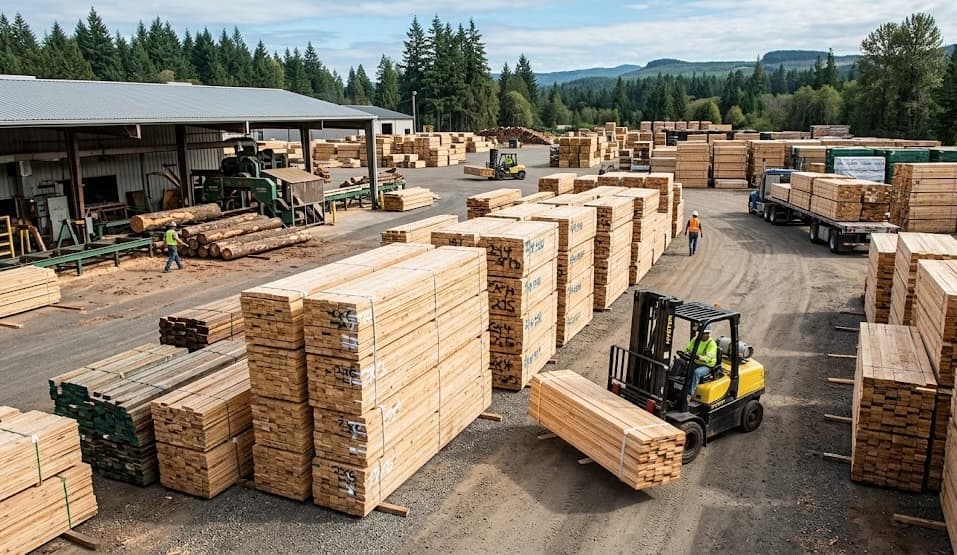
Proper stacking with stickers between every layer allows uniform air circulation during acclimation.
Kiln Drying vs. Air Drying
Kiln Drying
Lumber is placed in a controlled chamber (kiln) where temperature, humidity, and airflow are precisely regulated to remove moisture at an optimal rate. Modern dehumidification kilns recover the heat energy from extracted moisture, making them more efficient than traditional steam kilns.
1-8 weeks depending on species, thickness, and starting MC
6-12% depending on intended use
Advantages
- ✓Precise control over final moisture content
- ✓Kills all insects, larvae, and eggs at sustained temperatures above 133 degrees Fahrenheit
- ✓Sterilizes the wood, eliminating mold and fungal spores
- ✓Sets the pitch in resinous species, preventing future sap bleed
- ✓Can be completed on a predictable schedule
- ✓Produces the most dimensionally stable result
Disadvantages
- ×Requires specialized equipment and expertise
- ×Energy costs add to the per-board-foot price
- ×Overly aggressive kiln schedules can cause checking, splitting, and case hardening
- ×Thick timbers and beams may develop internal stresses if dried too quickly
Air Drying
Lumber is stacked outdoors with stickers (spacers) between each layer to allow airflow around every board. The stack is covered on top to shed rain but left open on the sides for ventilation. Moisture leaves the wood gradually through natural evaporation.
One year per inch of thickness as a general rule. A 2-inch-thick board needs approximately two years. Actual time varies with climate.
12-20% depending on climate and season
Advantages
- ✓Low cost -- no specialized equipment required
- ✓Gentle drying process minimizes internal stress and checking
- ✓Large quantities can be dried simultaneously with enough yard space
- ✓No energy costs beyond labor for stacking
Disadvantages
- ×Very slow, especially for thick stock
- ×Cannot achieve MC below ambient EMC (typically 12-15% in the Gulf South)
- ×Wood remains vulnerable to insect infestation during drying
- ×Weather-dependent -- rain and humidity spikes slow the process
- ×Mold and staining can develop during humid months if airflow is insufficient
- ×Not suitable as the sole drying method for interior applications in humid climates
Our Approach: Combination Drying
At Lumber New Orleans, we use a combination approach for most reclaimed lumber. Freshly salvaged material is air-dried under cover in our yard to bring the MC down from green (60-100%+) to a manageable range (15-25%). This slow initial drying minimizes stress and checking. Once the MC reaches the air-dry equilibrium for our climate (approximately 14-16%), we transfer the lumber to our dehumidification kiln for final drying to the target MC for the intended application. This two-stage process produces the most stable, highest-quality result.
Equilibrium Moisture Content (EMC) Explained
Equilibrium moisture content (EMC) is the moisture content at which wood is neither gaining nor losing moisture to the surrounding air. At EMC, the rate of moisture absorption from the air equals the rate of moisture loss to the air. The EMC value is determined by the temperature and relative humidity of the surrounding environment -- not by the species of wood.
The relationship between EMC and relative humidity is not linear. At 30% relative humidity, the EMC is approximately 6%. At 50% RH, the EMC is about 9%. At 65% RH, it rises to around 12%. And at 80% RH, the EMC reaches approximately 16%. These values are derived from the Wood Handbook published by the USDA Forest Products Laboratory and are consistent across all wood species.
Understanding EMC is critical for Gulf South projects because outdoor relative humidity in New Orleans averages 75-80% year- round, corresponding to an outdoor EMC of about 14-16%. However, air-conditioned interiors typically maintain 45-55% RH, corresponding to an indoor EMC of 8-10%. This means that wood installed indoors will reach a dramatically different moisture content than wood installed outdoors -- and wood transitioning from outdoor storage to indoor installation will undergo significant moisture loss if not properly acclimated first.
For reclaimed lumber projects, the goal is always to install wood at or very near the EMC of its final environment. This minimizes post-installation movement and ensures long-term stability. Calculate the target EMC based on the average annual relative humidity of the space (not the current humidity), accounting for seasonal variations in HVAC operation.
Seasonal Moisture Considerations for the Gulf South
The Gulf South climate presents unique moisture challenges for wood projects. New Orleans averages 75-80% relative humidity outdoors year-round, with summer readings frequently exceeding 90% and even winter readings rarely dropping below 60%. This creates a persistently high-moisture environment that affects every phase of a lumber project from storage through installation and long-term maintenance.
Spring and summer (April through September) bring the highest humidity and the greatest risk of moisture problems. Reclaimed lumber stored outdoors, even under cover, will absorb moisture rapidly. HVAC systems work overtime to dehumidify indoor spaces, and the differential between outdoor and indoor humidity can exceed 30 percentage points. This means lumber moved from outdoor storage to an air-conditioned interior must undergo significant acclimation before installation.
Fall and winter (October through March) offer more moderate conditions, with outdoor humidity dropping to 60-70% and indoor humidity sometimes falling below 40% during cold snaps when heating systems run continuously. This is the optimal season for exterior wood installation because starting MC levels are closer to the annual average. For interior installations, be aware that winter heating can dry wood below summer EMC levels, so plan for the average annual indoor conditions rather than the current season.
Regardless of season, we recommend running a dehumidifier in any enclosed space where reclaimed wood is being stored, acclimated, or installed. The additional cost of dehumidification is trivial compared to the cost of a moisture-related failure that requires tearing out and replacing installed material.
Need Moisture-Related Guidance?
All reclaimed lumber from Lumber New Orleans is kiln-dried to your specified moisture content and verified with calibrated pin meters before delivery. We take the guesswork out of moisture management.